

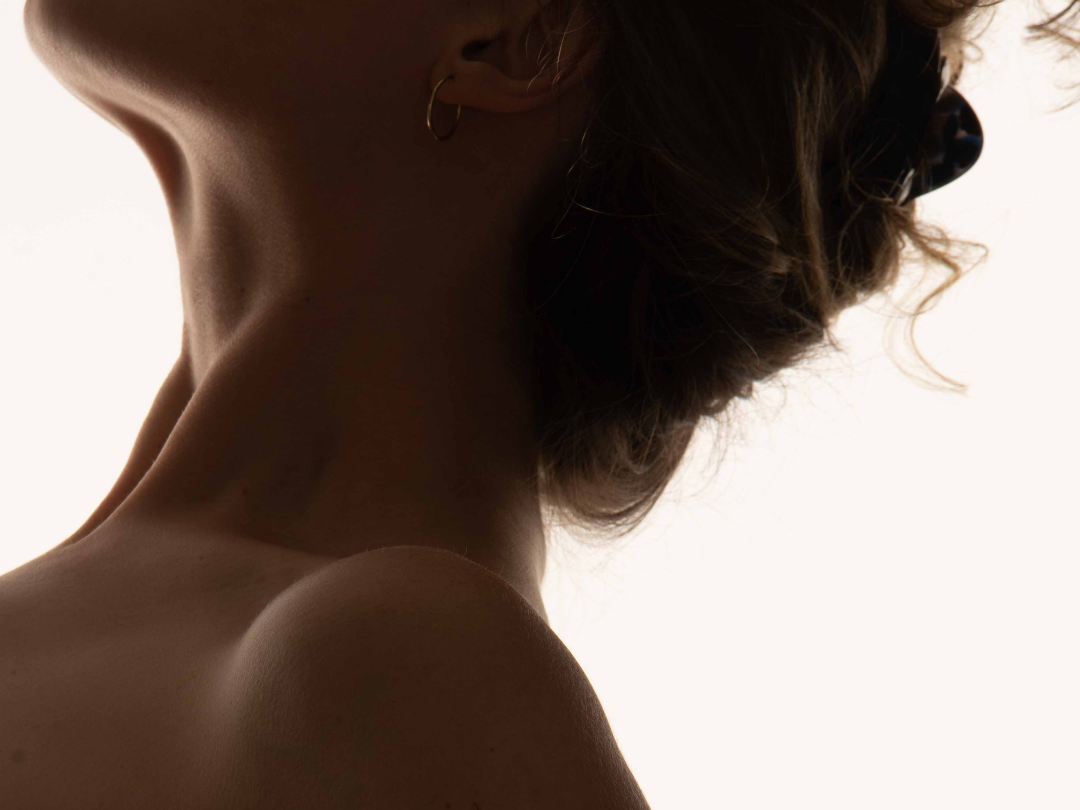
Photo by Brian Crawford (Shot By BOC)
If an artist’s main objective is to pursue, challenge, interpret, distort, or frame — and ultimately create — beauty, it feels inevitable that this yearning for and attention to beautiful things might eventually turn inward, or toward the self, as the creator of beauty. “I am going to make everything around me beautiful — that will be my life,” said interior designer Elsie de Wolf in her 1913 book: The House in Good Taste, a century before “around me” gave way, arguably, to a modern social media-oriented mindset: “including me.”
Because today, with GLP-1s, ‘tweakments’ (e.g. injectables: Botox, cheek filler, lip flips…), invasive surgeries (breast implants, BBLs, tummy tucks…), and a culture increasingly obsessed with aesthetic optimization via measurement (the Whoop band’s “24/7 health insights,” the Oura Ring’s “round-the-clock insights into wellness,” and the Apple Watch, marketed as the “ultimate device for a healthy life”), is the creator of beauty also expected to themselves be beautiful? Yes, I’d imagine, if all of us are, then why would the artist, an already mystical, mysterious being from one generation to the next, be any exception?
I would like to think that my making of beautiful things exempted me from attempting to create of me a beautiful self, but that would be wishful at best; naïve, or stupid, at worst. And I’ll broaden this to include all genders in a moment, but for now, consider the standard by which women in particular are held, especially as artists: Across music, film, art, and media, women are judged based on their body type, conventional attractiveness, and adherence to a status quo for beauty that men are not, as a prerequisite for recognition or success at all.
It’s easy to wonder: How else is an artist — especially a woman, but applicable to all — supposed to make people care about their work? If they won't take my art seriously, what's my next best bet but to deploy an aspirational personal brand? (I’ve always found it fascinating how much more social media engagement my mirror selfies get versus the work — art and writing — I pour my entire self into, and then somehow share to this bot-eat-bot digital world with vulnerability, acutely aware of its implication that, in sharing, I am exposing myself to criticism: my face, my body, my work, my words.)
What certainly doesn’t help is that, not only is the physical form expected to be beautiful in the first place, but then is expected to never show signs of aging, despite all of us aging every minute of every day. (In reality: The longer you live, the older you get, and both are the greatest privileges afforded the human in form, we forget.) In the midst of the contemporary “creator economy” — the creator, in this case, being the artist in the most traditional sense, the artist feels compelled to literally show face on social media. We, all of us — artists and otherwise — are in a tough position, ever making, ever aging.
How am I supposed to optimize — or, my God, maintain! — my sex appeal (the thing that supposedly generates attention on my work in the first place) if my forehead is starting to crease, my crow’s feet starting to crinkle? Reddit would recommend I laugh (or cry) a little less. My aesthetician would recommend Botox, obviously, every three months and no less. Trust me: I understand the impulse, or perhaps the finely calculated decision, to adhere to an impossible standard, even against my own good.
Self-care and (anti-) consumerism
I’m sorry to say that it gets more complicated. Because, and I’ve put on my marketing hat for this one, aesthetics and wellness are packaged and sold so closely together that the terms are now inextricably linked, implying that looking good is feeling well. (There’s a popular medical spa (‘medspa’) in my neighborhood with a folding sign out front that reads: “Look better, live longer,” as if the two were directly correlated.) In some cases, beauty and wellness are certainly partnered — eat well, and you’ll both feel and look better; the nourished body functions more optimally and has more energy, which supplies nutrients to the hair, skin, and nails, for example.
But in other cases, the two — aesthetics and wellness — are sold as one, but the consumer (you! me! us!) is hardly aware of that scheme. For example: Nail care is sold, or understood culturally, as a critical part of self-care. (How many times have you heard a man, for example, note that he’ll only date women who “take care of themselves” by keeping their nails consistently polished? I won’t get into the patriarchal undertones here, but it would be irresponsible for me not to mention it.) What we often don’t consider is that a trip to the nail salon for a fresh set means something like: You’re getting your natural nails thinned with a mechanical nail grinder (releasing particles which are not safe to inhale: skin cells, microbes, and chemical additives), your cuticles (a protective barrier which block bacteria, fungi, and viruses from entering your body) are getting cut and discarded, and those vulnerable nails are then topped with a toxic varnish before the hands are placed under a UV lamp, which increases exposure to harmful light — that can cause premature aging, photosensitivity, and even cancer.
Hear me: I am not telling anyone to not get their nails done. (I, myself, love an absolutely outlandish and atrocious spiked Barbie-pink claw on occasion.) What I am saying is that the system has literally done us dirty, selling us this idea that self-care requires bodily harm or manipulation; that self-care is the same as what “looks good”; that self-care is expensive — a consumer’s righteous duty to upkeep if they want to be well, and a non-negotiable if they want to be beautiful.
As a marketer by (day) trade, I am particularly skeptical of marketing strategies, and the way in which both wellness and aesthetics industries are growing — and consumerism as destructive, unsustainable, and mindless — causes me concern: We’re oversold and under-informed.
Botox and the body
In the same way that beautiful (or perfectly manicured) nails is aesthetics but is not self-care, Botox is aesthetics but is not wellness. Botox (Botulinum Toxin) is the brand name of a prescription drug made from the bacterium Clostridium botulinum, the same toxin that causes a life-threatening form of food poisoning. Similar to GLP-1s, its inherent use is neither good nor bad, right nor wrong — in many cases, GLP-1s and Botox both are medically important and absolutely improve the lives of their users. (If your Botox injector is, in fact, informing you of all this, I applaud them, although it’s more likely they’re working on their upsell: more units, more frequently, and also, maybe consider laser since you’re already here so often?)
The toxin works by paralyzing the muscle into which it’s injected to keep that muscle from moving, thereby reducing or preventing creasing of the skin. But the body is a dynamic, living, interconnected, and incredibly intelligent system, face and head included.
In any other part of the body — let’s say we’re referring to the shoulder, the calf, the diaphragm — paralysis would be considered explicitly dysfunctional (medically: motor system dysfunction or muscle function loss). Even if the tissue itself is healthy, paralysis renders the neurological signal between brain, spinal cord, and muscle fibers ineffective: the feedback loop is broken. And, over the long term, that paralysis can affect the otherwise healthy tissue via muscular atrophy (weakness) or spastic paralysis (stiffening), among others.
You’d not want the shoulder, nor the calf, nor the diaphragm to be weak or stiff or neurologically impaired; they need movement (and lots of it!) to maintain their elasticity. For muscles to lengthen and contract is the body’s foundation of all physical expression, posture, and vital organ function — the beat of the heart, the undulation of the breath. Healthy musculature is aesthetics, but it’s also wellness, too.
Feelings and the face
I am an advocate for all humans to be happy and healthy, but this information is all the more imperative for the artist whose main objective is uninhibited expression.
More than just expressing emotion (e.g. a furrowed brow in response to an anxious thought, squinted eyes in a fit of laughter), facial expressions also conversely help to create feelings themselves, informing the brain in a feedback loop similar to that between the spinal cord and muscle fibers in functional movement of the body. Perhaps you caught that study which revealed even forcing a smile can boost your mood; activating the smile muscles (even without smiling naturally, as a product of joy) can trigger the release of the neurotransmitters (or ‘happy chemicals’) dopamine and serotonin. It’s called the Facial Feedback Hypothesis.
(Before I continue with my point: It’s important for me to play my own devil’s advocate for a moment. While inhibiting muscular movements of the face may dampen the individual’s ability to fully process an emotional signal, and therefore feel that emotion, this can be really helpful in the case of debilitating anxiety or depression. Injections into a chronically furrowed brow can alleviate the negative feelings that furrowed brow signals the brain to feel — concern, worry, fear, overwhelm, anxiety, etc. It can offer the individual emotional relief in that way, so just as no treatment is inherently good or bad, right or wrong, sometimes they are genuinely beneficial to the body, based on individual needs and goals.)
The English word emotion is rooted in the Latin emovere, which means to “move out,” “remove” or “agitate.” (Perhaps you’ve heard this before: “e-motion is energy in motion.”) Those bodily sensations need somewhere to go to complete their cycle of information delivery, of existence and dissipation. When that energy’s cycle is stunted, it often becomes lodged in the body as tension — blocking movement fluidity, mental clarity, and creative flow. In Eastern philosophy like Traditional Chinese Medicine (TCM), that vital energy, Qi, is life force itself, commanding the blood to pump through our bodies to effectively nourish our tissues, organs, and minds.
In the case of aesthetic pursuit, impairing that signal (like, with the use of Botox) disrupts the brain’s ability to process that facially expressive information. The face can’t do what it does naturally — furrow the brow, squint the eyes — and the signal which informs the brain “this is what I’m feeling” is rendered incomplete. That feedback loop doesn’t loop, and the energy of that emotion gets stuck in the muck of the tissues themselves.
Empathy and creative expression
This facial-feeling feedback loop impacts the individual in a siloed experience, but it’s interesting, too, in response to others, for the way in which it impacts empathy specifically. Suppressing facial expression (either intentional in a stoic sense or via paralysis with Botox) during a conversation can increase stress levels and block clear (i.e. non-verbal!) communication. Humans are social creatures; we mirror the behavior of others, even subconsciously, in an effort to find connection, belonging, and safety. It’s not an intentional behavior but a biological one, the glue of our ancestors in close-knit communities and tribes.
The micro-movements of our facial expressions are no different, mirroring the person with whom we're interacting. When this signal between two people is dampened, the other has to rely more heavily on context cues, tone of voice, and logical thinking rather than raw, human, automatic physical intuition.
But empathy is complex, because even though it can be triggered as a reaction to someone or something happening out there (a state of mind in response to a neighbor in distress or a heartbreaking news story, for example), it’s also constructed as a baseline personality dimension within an individual (a trait of being thanks to higher consciousness or acute self-awareness).
Empathy — the emotion (affective empathy) and way of being (cognitive empathy) — is triggered externally but constructed internally, a self-contained capacity to feel into the expanse and richness of life beyond your immediate personal experience. It’s a playful, sometimes painful, gateway that frees us from the limits of our own ego. (Ask any artist who’s been able to maintain their creative practice without growing to resent it, and dying to the ego is a daily duty.)
Art as inherently non-capitalist work
The aesthetics industry is a market raking in about $32 billion globally in 2026 (with Americans representing 54% of that number) and projected to grow to nearly $90 billion by 2034. But aesthetics, by traditional definition, has nothing to do with what they’re trying to sell you: It’s the philosophical branch which “studies the nature of beauty, taste, art, and the emotional responses they trigger.” The word itself is derived from the Greek origin aisthetikos, translating to “of sense perception,” which is the process of collecting information about our external worlds by our senses, then pieced together by our brains to create our unique versions of reality. We’re all well aware of the traditional senses, taught in elementary school (sight, hearing, smell, taste, and touch), but there are others, too, which construct our realities: proprioception (your body’s awareness of itself in space), vestibular sense (balance and orientation, governed by the inner ear), and, pertinent here: interoception (the ability to perceive the inner state of your body).
A dependency on (or overuse of) modern-day aesthetic practices disrupt our bodies’ natural states of flow. If Botox inhibits communication between the facial muscles and the brain to feel an emotion to its fullest; a GLP-1 medication sends signals to the brain which say “I’m satiated," even when the body itself is hungry; and tracking devices make interoception obsolete by outsourcing the body’s signals, we might be (arguably more) beautiful, but are we truly happy? Are we actually healthy?
When we’re cut off from the body and its natural systems, or we perpetuate dysfunction with under-informed ‘aesthetics,’ when we resent the body for having lived longer than yesterday's version, we cut ourselves off from feeling, from intuition — expression of the most natural, most unique, most authentic version of ourselves. Can the artist express herself with full authenticity, embodied intuition? Intuition — and its artistic output, intuitive creativity — is an effect of the body, its natural release, natural, embodied expression: What feels like the next best move? What colors, textures, words, phrases, notes, keys, are feeling authentic to the experience right now?
“Your feeling is the secret that decrees your creation,” writes David Kasneci in Project 369: The Key to the Universe, which outlines the energetic force underlying manifestation — for which the artist is uniquely and perfectly primed, giving form to energy with every stroke of the piano key, every stroke of the paint brush.
The artist at play
There’s so much talk of “anti-aging” to instill in us a fear of aging. When we fear something, we give it power (and piles and piles and piles of money). And when we give something power, we offer it headspace: attention. If we were to immediately call back our attention from this thing we are programmed to fear, then we could allocate it to something more productive and at its core, non-aging, timeless: the present moment. (And it’s really all we have, anyway.)
Elaine Scarry lists beauty’s features in Part One of her 1999 book, On Beauty and Being Just, “First, beauty is sacred…Second, beauty is unprecedented,” in that comparison is fruitless — the beauty of one thing doesn’t take away the beauty of another (and in fact, she argues that the beauty of one thing adds to the beauty of another, as our capacity to receive and relish in beauty increases). “But there is also a third feature: Beauty is lifesaving…[it] quickens. It adrenalizes. It makes the heart beat faster. It makes life more vivid, animated, living, worth living.”
And later, in Part Two, she writes, “One key source of continuity between beholder and beheld [is] strikingly evident…the way each affirms the aliveness of each other…This begins with the confined circumference of beholder and beheld who exchange a reciprocal salute to the combination of one another’s existence; this two-member salute [between art and artist, for our purposes here] becomes, by the pressures against lateral disregard, dispersed out so that what is achieved is an inclusive affirmation of the ongoingness of existence. And of one’s own responsibility for the continuity of existence.” It wasn’t necessarily her intent to discuss the artist’s practice, but in this exchange we discover the artist’s purpose: In considering the perceiver and creator, “we enter into the live actions of perceiving and creating, and are therefore carried to the subject of aliveness, our final goal.”
And beauty itself is in the eye of the beholder: There is no standard by which all nose jobs should be held. Sometimes, the aesthetics conversation is about what makes something ugly, even — or artistic (!) in the first place. The point isn’t sameness, and it certainly isn’t perfection, but emotional evocation — with homogeneity, perhaps, as its ugly (or boring) opposite — for it’s the life, the dynamism, the novelty in something that makes it worth our second take, and maybe our sustained attention. It’s the way something makes us feel, and when everything looks the same, what moves us but those things that are most unique? Let us let ourselves wrinkle — thankful that every new etching is uniquely our own, a representation of the life we have lived distinctly from anyone else, across all of human history.
Perhaps we’re obsessed with youthfulness because it points to aliveness. But youthfulness isn’t the only factor in aliveness — it’s just one particularly emphasized by capitalist modernity, a never-ending funneling of funds to achieve the impossible. What this behemoth of an industry doesn’t want you to know is that despite your increasing distance from birth, from youth as a chronological marker, you can actually become more and more and more alive, in energy and in flow and in radiance and in the richness of living.
So, here’s my advice: Make art with abandon, and in your process of making, devote your attention to what’s happening now — be fully invested in this moment of play. Let it be fun! Let it be wild! Let it be anything at all, imaginative and strange or silly or simple or whatever, however, whenever. Let it be childlike in its freedom to be, unburdened by optimization and unattached to the outcome.
Because — and here’s the secret — the “fountain of youth,” which modern aesthetics promises comes in a product, is actually a feeling — whatever is invigorating, expansive, energetic, alive. My pitch is for all of us to feel more, not less (!) because there is no product nor potion as potent, none as enlivening, as play.
In application: 7 tips to cultivate wellness and (individualistic!) beauty
I am so thankful to live in a moment in history when we get to express ourselves the way we want, that we understand pretty thoroughly what contributes to visible aging, and that we can help alleviate those visible indicators that age (or change) is taking place. In the same way that there is no one right way to be an artist, there is no one right way to engage with our individual beauty, or its shape over the course of our lives. The individuality of it all is, in fact, the point.
Of course: Your body is your domain, co-created with Source, Universe, God, Being; a physical embodiment of that force that enlivens you from the inside-out.
Here are some ideas to exercise this, whether you take an entirely granola approach to wellbeing, or you are absolutely committed to your quarterly injecta-schedule:
My first and only true request of you is that you get clear on your personal values, and let those guide your lifestyle, habits, and spending behaviors. I am as much a skincare girlie as the next guy (my bathroom counter will prove it), but my individual value system — e.g. feeling embodied as a priority — shapes my decision-making around beauty and wellbeing. (Note also that #10 in my Personal Constitution is to stay adaptable. I am water, ever flowing and constantly evolving, so changing my mind at any point is allowed and encouraged.)
If art isn’t accessible or interesting to you, there are other ways to experience the catharsis of stuck energy in the body (whether a product of Botox or emotional suppression). Crying (!!!), exercising, diaphragmatic breathing, and Vagus nerve stimulation also help to relieve physical tension by down-regulating the sympathetic nervous system (flight-flight-or-freeze response) and activating the parasympathetic nervous system (rest-and-digest response). The wear and tear on your body is faster in a chronic stress-state, accelerating both the feeling of and the appearance of aging.
Prioritize healthy posture whether you’re sitting at your desk, standing at the canvas, and in the details of your day. Your face and head are not siloed in form, separate from the body as a whole, but are instead the top-of-chain expression which can represent dysfunction from all the way down in the feet. Maintaining healthy skin is just one piece of the puzzle, but it’s incomplete to disregard the structure on which the face sits: the cranium. In particular, asymmetry, tightness, or weakness in the hips and pelvic floor can influence the presentation of the skull and jaw — and therefore, the face — via the deep front myofascial line (the “pelvic-jaw connection”). Addressing common forms of postural dysfunction due to sedentary lifestyles and constant use of tech — like a pelvic tilt (either lateral, in which one hip is higher than the other, or anterior or posterior in which the pelvis is tipped backward or forward) or forward head posture — can help both your physical presentation at the level of the face and is beneficial for overall longevity in life and in art-making.
Emphasize longevity over virality: Instead of trying to “make it” as an artist (whatever your art) by a certain age or milestone, redirect some of that attention toward increasing your longevity. True artists are, in fact, benefitted by age. The more you know yourself, the more authentic your practice. The more authentic your practice, the more joyful creating becomes. Longevity is one of our greatest privileges (and that means aging! as death’s alternative), and if you have any control over it, exercise that control.
Further, by extending the length of time in which you are physically and mentally able to create in the first place, it will relieve that pressure that drives you to figure it out faster. Be gentle, be patient, and play the long game.
Limit data outsourcing to determine how you feel: Your body is incredibly intelligent, and it will speak to you, given the space and safety to do so. Consider that digital monitoring devices (like the Apple Watch, Whoop, Oura Ring, etc.) might be inhibiting your ability to be embodied. These tools can be a fun way to understand our bodies more intimately, and are sometimes helpful to understand our health metrics for immediate improvement, but be wary of dependency; without engaging mindfully, they might be training you to rely on external factors to evaluate your state of being as opposed to getting into the body — reconnecting with it as the incredible piece of creation that it is, a physical manifestation of Infinite Intelligence.
Check in with yourself: Are you hungry because you feel hunger, or because your clock says it's 3pm? Are you cancelling your plans with friends because you feel under-rested, or because your Oura’s Sleep Debt prompted some anxiety?
Cultivate a greater sense of embodiment with a formal meditation practice, emphasizing body scanning, emotional attunement, breath counting, observation of the senses, and open awareness. Other modalities like somatic grounding, gentle movement, and dancing (!) are helpful, too. If you’re interested in practicing embodiment alongside others, I recommend yoga (but not the aesthetic-oriented kind), tai chi, qigong, or pilates, as all emphasize the breath — a key factor in shifting your attention from the mind (headspace) to the body (heartspace).
Offer your own (ever-changing, always-aging) beauty a little more grace. A flower in full bloom is just as breathtaking as its first bud of spring; and let us not overlook the devastating, heart-aching beauty of a flower in a vase on the table, having dropped a few petals while wilting. It’s because “beautiful things,” writes Scarry, “as Matisse shows, always carry greetings from other worlds within them.” Consider that what makes something beautiful in the first place is its impermanence, in the (timeless) eternal unfolding of (time-stamped) now.
If this resonated with you, I think you’ll love: The Artist’s Guide to Holistic Wellbeing: Cultivate Your Creativity in Mind, Body, Soul, and Space.
